
“We must find sources of strength and renewal for our own spirits, lest we perish. We must learn to be quiet, to settle in one spot for a period. Sometimes, during each day, everything should stop, and . . . the art of being still must be practiced until development and habit are sure.” –Howard Thurman, “Dilemmas of Religious Professional, Part 3, 1971 February 11“
Over the past few years, the Center for Spiritual Imagination has focused on creating new pathways for people to engage with contemplative practice. Although contemplation is inherent to Episcopal (and, by extension, Anglican) tradition, woven into “The Book of Common Prayer” and the rhythms of the liturgical calendar, it is shocking to converse with leaders, both ordained and lay, who do not view contemplation as a necessary part of their ministry.
I believe this disconnect happens for several reasons. First, contemplation is often viewed as overly mystical, something not easily approached or adopted in a simple way. Second, people often feel that the practices lack a regular, accessible rhythm. And maybe most importantly, the challenge lies in how we define the word itself. Some equate contemplation with meditation, mysticism, or simply “gazing.”
What Is Contemplation?
We in the Community of the Incarnation define contemplation broadly as a prayer practice that allows us to make conscious contact with God. The aim of contemplation is not to master a technique or to remain silent for the sake of silence. Rather, it is to create patterns and to shift our perspective so that we make conscious contact with God whenever we are able. While we cannot all be Brother Lawrence, practicing the presence of God at every single moment, that remains our aspiration: to be in contact with the Divine at all times.
Why do I begin with this idea? Primarily because I find that Christian leaders often fail to see how vital contemplative practices are for us.
As a vowed member of the Community of the Incarnation, I have embraced contemplation as part of my Rule of Life. The more I engage and practice contemplative prayer, the more grounded and connected I feel to my internal life, my community, and our complex world. Currently I am balancing preparing for the priesthood, managing academic coursework, fulfilling community responsibilities, directing the Black Lives and Contemplation project, while navigating parish life and volunteering duties. While all of this could easily feel untenable, I find that contemplative practice reinvigorates me and keeps me anchored in hope during these trying times.
The wise Dr. Howard Thurman calls for us, as people, to develop an interior life, a “well” from which to draw when life gets difficult. The quote I shared above, from his lecture series on the need for prayer in ministry, follows his assertion that for ministers to truly engage in a life of prayer, they must practice it, not just preach it. He notes that it is often easier for a minister to teach about prayer than to actually engage in prayer practice.
And this serves as a crucial reminder, even for me, to consistently engage in contemplative prayer practices. I believe contemplation is the path to healing the ways we show up in the world, the ways we lead. But it is by embracing imaginative ways to enter into contemplative practices, to make conscious contact with the Divine, that I believe we can effectively unlock transformative new dimensions of ministry, empowering both our personal lives and our communities.
Contemplation That Brings Liberation
At the Center for Spiritual Imagination, we hold that the call to contemplation is universal and offers us diverse pathways to listen and respond to the Divine. We introduce people to this call through different methods, centrally featuring our Incarnation Method of Prayer, alongside practices like Musica Divina, Lectio Divina, and Visio Divina, all designed to deepen one’s inner life (you can learn more at our “Practice Guides” page). We believe that developing this inner life through contemplation is the vital pathway to achieving liberation for all. This approach, which I recently termed “Liberative Contemplation” for the Community’s Substack, asserts that if conscious contact with the Divine is the goal, leading ultimately to freedom, then the practices themselves must be inherently liberative and imaginative.
Imaginative contemplation is crucial because it is the path to a contemplative life that I wholeheartedly believe brings liberation and transformative change to the world. And this is echoed by Fr. Ian Cowley, who writes of the importance of contemplation for our ministries: “This is what I now see as contemplative ministry. This ministry begins with the care and right ordering of our own hearts, and it leads to the transformation of our society, and of the world” (“The Contemplative Minister: Learning to Lead from the Still Centre” [Bible Reading Fellowship, 2015]).
We change the world by first tending to our inner lives, by fostering a deep life of the interior. This deep interior life must be rooted in the Divine, the place where we reclaim our Imago Dei, an identity unburdened by society’s expectations. Here we hear God’s unique voice and are then empowered to share that truth with the world. This is how we join Jesus in his mission, a mission beautifully summarized by the late, great prophet of Brooklyn, The Notorious B.I.G., to “spread love” the Brooklyn way (“Juicy”), but maybe even more importantly, the Jesus way.
A Liberating Invitation
My invitation, therefore, is to embrace contemplative practice to enliven our leadership and deepen our prayer life, and I am confident that this dedication will bring about true liberation for us and our communities. If we genuinely believe that “for freedom Christ has set us free” (Gal 5:1) and that Jesus acts as an agent of liberation for all marginalized people, then contemplation is a pathway to actualize that freedom.
To help embrace this practice, maybe you can join us at the Center for Spiritual Imagination for some of our offerings. You can come and learn a new prayer practice by joining our online contemplative prayer every Monday at 6:30 p.m. ET. Or, if you are feeling more adventurous, looking for some imaginative pathways to contemplation, join one of our monthly Hip Hop meditations.
By engaging in these contemplative prayer practices, we cultivate the hope required for these trying times. As the great prophets from Long Island, De La Soul, remind us in their song “Believe (In Him),” it is “on bended knee” that we learn to “dodge the wolves of this age.”
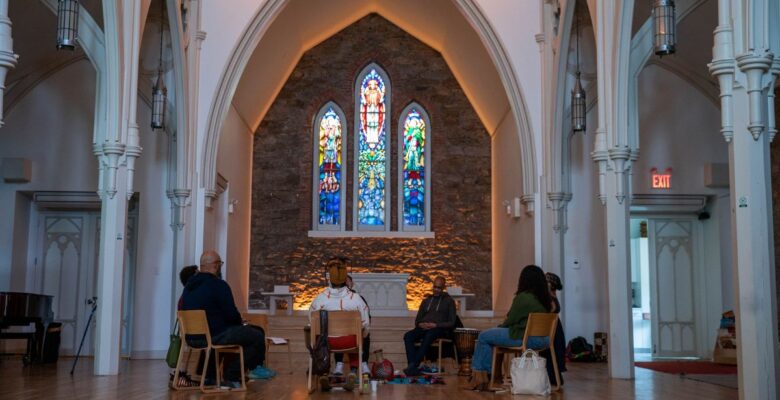
Featured image shows one of the Center for Spiritual Imagination’s Center Down contemplative sesssions and is by provided by article author, Guesnerth Josué Perea
Reading this reflection on contemplation felt like a gentle invitation to return to the quiet center of the soul. The reminder that ministry must grow from an interior life resonated deeply with me, because true leadership—whether in faith, teaching, or personal growth—begins in stillness and awareness. The idea that contemplation creates a well of strength from which we serve others is both profound and practical. It beautifully illustrates that sustainable ministry is not sustained by constant activity, but by a rhythm of listening, reflection, and renewal.
I’m glad you found the article helpful, Daniel! Thank you for sharing!