
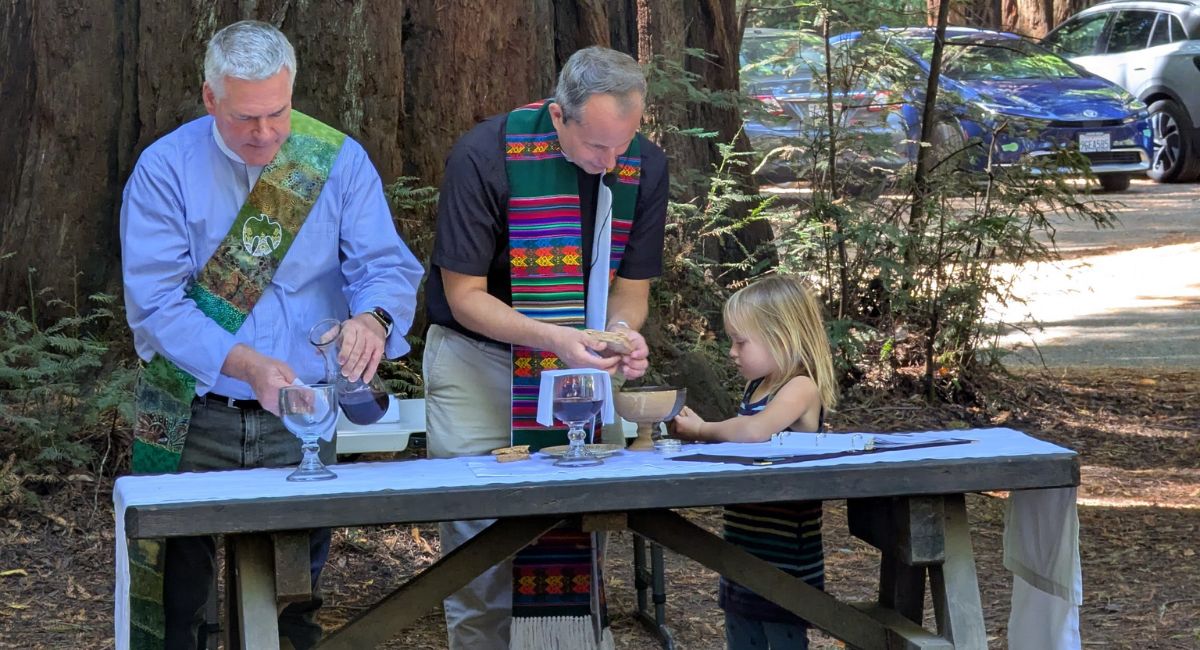
“Expressions of Intergenerational Liturgy” is a series developed through Roots & Wings: Intergenerational Formation Collaborative. Rather than a formula or prescription of vibrant intergenerational worship, we hope this series will inspire contextual creativity and expanded imagination for intentionally engaging and equally valuing the gifts and needs of all generations in the liturgy.
Church of the Incarnation’s Story
History & Vision for Intergenerational Worship
Like many congregations, The Episcopal Church of the Incarnation in Santa Rosa, California has a long history of holding children and youth formation programs during the main worship service, effectively segregating the congregation by age on Sunday mornings. Over the last eight years, leaders have been working to bring generations back together during the liturgy by creating regular opportunities for intentionally intergenerational worship. For the rector, the Rev. Stephen Shaver, this comes from, as he said to me in an interview on May 18, 2026, “a deep commitment to the baptismal ecclesiology of the Book of Common Prayer 1979 which explicitly includes children as full members of the church.” When Stephen arrived at Church of the Incarnation, he found that Daphne Vernon, the Director of Spiritual Formation, shared his vision.
Separating Worship & Formation
In 2020, the COVID-19 pandemic disrupted patterns of worship and programming for all of us. As Church of the Incarnation began to regather onsite, Stephen and Daphne took the opportunity to separate Christian formation from worship. Worship now occurs at 8:00am and 10:15am with different Christian formation programs for various ages taking place at 9:00am. During the 10:15am liturgy, the church offers nursery care and Children’s Chapel, but their website makes clear: “Children are always welcome in worship: any age, any time.”
Experimenting with Intergenerational Liturgy
In the last two years, Church of the Incarnation has been experimenting with intentionally intergenerational liturgy through “Discovery Sundays.”
Leaders chose the name “Discovery Sunday” because, Stephen says, “there was a memory within the congregation of ‘Discovery Sundays’ when children and youth led worship about ten or fifteen years ago.” While the current iteration of “Discovery Sunday” is likely very different from what took place over a decade ago, Stephen explains that “using this name allowed them to ‘piggy back’ on something old, rather than starting something completely unfamiliar to the congregation.” Stephen says this is the way they have “tried to improve ministry with children little by little, finding the place where water runs downhill instead of uphill.”
These liturgies are planned by a small team that includes Stephen, Daphne, the Children’s Chapel musician (Robin), a parent from the congregation, another congregant involved in ministry with children, and the non-stipendiary associate priest, Bill. Discovery Sundays intentionally bring all ages together for worship during the 10:15am service and share a bit of the “spirit of Children’s Chapel” with the wider congregation. The goal is to center children through:
- shorter, simpler sermons aimed at the whole assembly
- offering children as many liturgical leadership roles as possible
- using simplified language for prayers and readings.
Discovery Sundays utilize Holy Eucharist Rite III (with the permission of the Bishop) but closely follow “The Book of Common Prayer.”
Just as leaders chose a familiar name for their intentionally intergenerational services, they are intentional in their selection and adaptation of prayers and music. Although Discovery Sunday flips the script by centering children in a usually adult-centered space, the leadership team wants the service to feel familiar and accessible to all generations. As the bulletin states, “Our Discovery Sunday services are times when our 10:15 service is designed for people of all ages to worship together in an accessible way.”
Feedback, Reflection, Iteration
Stephen’s recounting of communion during the first Discovery Sunday demonstrates the complex nature of experimenting with liturgical change:
“For our very first Discovery Sunday, I decided to be kind of bold and have two children serve Holy Communion. I called them Junior Eucharistic Ministers and I had each one of them shadow a cleric. The cleric was with them and assisting them, but the child would put the bread into the person’s hand and say, ‘The body of Christ, the bread of heaven.’ I did a congregational survey after this first Discovery Sunday. About five people wrote in and said, ‘Receiving communion from a child was so moving. It was this profound experience. I felt the connection we had. I felt her love and awe and delight in this ministry.’ And about five people also wrote and said, ‘Receiving holy communion from a child was very distressing for me. This wee slip of a girl cannot possibly know what she is doing. She was handing out the body of Christ like it was just normal bread, and I am profoundly disturbed by this irreverence to the holy sacrament.'”
After receiving this feedback, Stephen moved to having Junior Eucharistic Ministers stand at the altar and elevate the bread and wine, but not actually serve communion to the congregation. But, he says, he might try having children serve communion again in the future. “The same people that were worried about children distributing communion also feel it is inappropriate to have small children behind the altar at all,” he notes. There are folks who simply find a more child-centric liturgy difficult to engage. While their perspective matters, so does the perspective of those who found receiving communion from a child deeply meaningful.
Where Things Stand
Currently, Church of the Incarnation celebrates Holy Eucharist at 8:00am and 10:15am. During the 10:15 service, nursery care is available for very young children, and Children’s Chapel is available for pre-K and elementary-age children during the first half of the liturgy. Christian formation programs for various ages take place between services at 9:00am. All generations gather for an intentionally intergenerational liturgy called Discovery Sunday a few times a year.
Next Steps
Stephen does not know if Church of the Incarnation will ever see Children’s Chapel “wither away” and weekly intergenerational liturgy become normative. But he does imagine the number of Discovery Sundays increasing from twice a year to perhaps four or five, and he also hopes to find ways to “cross-pollinate” so that children who lead in Discovery Sundays can also begin taking more leadership roles in the regular 10:15 liturgy.
Additionally, Stephen is hoping to offer a dedicated training specifically for children who will serve as Junior Eucharistic Ministers at Discovery Sundays. This training would provide logistical instruction (i.e. what to do), but more importantly, it would offer Stephen an opportunity to share why we do what we do in liturgy (i.e. what is happening when we elevate the bread and wine?).
Context Profile
In imagining how the practice of another worshiping community might translate to your context, it is important to have some background information on the original context.
Context Profile for Episcopal Church of the Incarnation (Santa Rosa, CA)
- Average Sunday Attendance: 155–160
- Age Ranges & Ratios: Around a dozen core families with 15 or 20 children, currently less than a half dozen middle and high school youth
- Location: Downtown, Santa Rosa, CA (a metro region)
- Cultural Context: West Coast
- Liturgical Style: “Higher than center (incense on feast days, chanting almost every Sunday), but with a degree of warmth”
- Discovery Sunday Leadership Team: The Rev. Stephen Shaver (Rector), Daphne Vernon (Director of Spiritual Formation), Robin O’Brien (Children’s Chapel Musician), The Rev. Bill Glenn (Assistant Pastor), two lay leaders from the congregation
- Church Website: www.incarnationsantarosa.org
Things To Notice
I want to highlight a few aspects of Church of the Incarnation’s expression of intergenerational liturgy that Roots & Wings Resource Developer Jodi Belcher and I noticed:
- Formal/Traditional Context: Leaders often assume intergenerational liturgy only happens in quirky, small, informal church contexts. This is a myth. Church of the Incarnation is a great example of intentionally intergenerational liturgy in a formal/traditional context.
- Culture Change Is Complex: This is a story of a complex process of leading a community toward intergenerationality in a way that holds many pieces (values, gifts, needs, etc.) for many people together. Stephen’s approach embraces collaboration by trying, adjusting, listening to feedback, and iterating. While initiated by the rector, it is not a forceful, top-down approach. Stephen leads with patience: moving together as a community, speeding up in places of comfort and slowing down in places of discomfort without giving up on the vision. The vision is shaped not only by the values of the leaders, but by the worshiping community and the existing liturgical style.
- Feedback from Young People: In our conversation about children serving communion, Stephen wondered whether or not eucharistic ministry is “a felt need” of the children themselves. This wondering highlighted the need and opportunity to solicit the reflections of young people as well as adults.
For Reflection
- Where does the “water run downhill” in your context? Leaders at Church of the Incarnation looked for easy wins and existing energy, for example, repurposing the name “Discovery Sunday” instead of introducing a new worship service no one had ever heard of. What practices, memories, events, or values are already present in your context that you could build upon to move toward more intentional intergenerational liturgy?
- How does your leadership team navigate feedback around liturgical change?The first Discovery Sunday generated passionate responses from some who were deeply moved and some who were deeply troubled by the same experience. How do you currently handle feedback in your context? What processes or relationships might you need to develop before experimenting further with intergenerational liturgy in order to better navigate the competing needs of your worshiping community? What would help you stay curious and in relationship rather than responding defensively?
Additional Resources
Discovery Sunday Bulletins from Church of the Incarnation
- Discovery Sunday, The Fourteenth Sunday after Pentecost, September 2025
- Discovery Sunday, The Second Sunday of Advent, December 2025
Reflection Guide for Episcopal Church of the Incarnation, Santa Rosa, CA
Use this two-page worksheet to compare your context to Church of the Incarnation, make notes on the reflection questions, and plan out some next steps.
“Children and the ‘Book of Common Prayer'” by Stephen R. Shaver
Chapter 14 in The Oxford Handbook of the Book of Common Prayer, edited by Ruth A. Meyers, Luiz Carlos Teixeira Coelho, and Paul F. Bradshaw (Oxford University Press, 2026)
Featured image is provided by Stephen Shaver
Leave a Reply