
“In the name of our God, I ask you to have mercy upon the people in our country who are scared now.” On January 21, 2025, The Rt. Rev. Mariann Edgar Budde, bishop of the Episcopal Diocese of Washington, preached these words at the Washington National Cathedral’s Service of Prayer for the Nation, speaking directly to Donald Trump, the newly inaugurated president of the United States.
As is well known, Bishop Budde’s sermon generated an enormous response. While some vilified the bishop and considered her sermon inappropriate, for others her invitation to have mercy provided a fundamental orientation for Christian behavior in confusing and fraught times.
The varying responses to this sermon and the hunger that her sermon stirred for further theological framing of this challenging political moment convinced members of the faculty of Virginia Theological Seminary (VTS) and our affiliated institution, The General Theological Seminary (GTS), that it would be valuable to reflect on this moment from our various theological disciplines. Our goal was to provide a theological interpretation of our current political context that would be helpful to Christian leaders and to all people of faith, helping them to make sense of our time of political crisis and discern how best to respond to it. In the bishop’s heartfelt plea—that the president have mercy—we heard a political and theological claim, inviting us to ponder our own political visions and how they arise from our particular theological commitments.
The Book
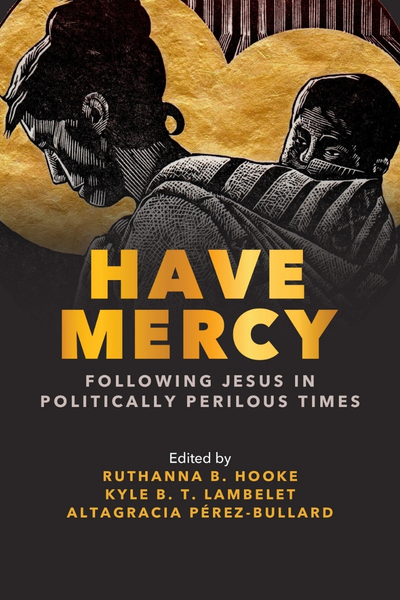
The forthcoming volume, “Have Mercy: Following Jesus in Politically Perilous Times” (Church Publishing, 2026), is the fruit of these reflections. The book features essays from theologians, ethicists, liturgists, and pastors, all of whom are affiliated with VTS or GTS as faculty, staff, students, or alumni. Each essay considers one basic Christian commitment, contextualizes that commitment in the liturgy, history, theology, ministry practice, or scripture of the church, and articulates how that commitment takes on political significance in this particular moment in the United States. Each entry concludes with discussion questions that could serve as prompts for conversation in communities of faith, perhaps in an adult Christian formation group, book club, or Sunday School. The entries also list several additional resources that readers can consult to deepen their engagement with the topic. Together these essays explore the power of the gospel for our times and provide resources to Christian leaders and the faith communities they serve.
The book is organized into four sections:
- The politics of Jesus: The first section reflects on what the politics of Jesus are and how they differ from common understandings of politics. Bishop Budde’s sermon, in urging the president to have mercy, was making political claims in the public square, yet these claims point to the particular politics of Jesus, which are dissimilar to the typical ways that we practice politics in the United States today.
- The virtue of mercy: The second section of the book probes the theological and scriptural roots of the Christian virtue of mercy.
- Practices of mercy: The book’s next section considers specific practices of mercy, such as love of enemies, the raising up of merciful leaders, and the necessity of speaking for marginalized persons in our society.
- Sustaining mercy: The final section of the book reflects on practices, such as prayer, community-building, and the cultivation of beauty, that allow followers of Jesus to sustain practices of mercy over the long haul.
Our hope in writing this book is that it will provoke conversation in churches and other communities. We also hope that these essays will be both a balm and a challenge for readers as they discern their own faithful responses to these politically perilous times.
An Excerpt
As an example of the essays in this volume, my entry considers how Bishop Budde’s sermon involved a confrontation between two types of power: the political, military, and economic might of the presidency, on the one hand, and the power of the gospel, on the other. St. Paul describes this latter power as foolishness and weakness; yet, paradoxically, “God’s foolishness is wiser than human wisdom, and God’s weakness is stronger than human strength” (1 Cor 1:25, NRSVUE). This is a power that the rulers of this world are mysteriously unable to subdue and that instead upsets and stymies them. This divine power is on display in the Acts of the Apostles, in which the Holy Spirit gives the early disciples of Jesus the power to bear witness to Jesus Christ in the face of persecution, allowing them elude the powers of empire time and again.
Considering how the Spirit’s work in Acts can guide us in our times, I suggest the following:
“The Spirit gives us the authority and the courage to proclaim Jesus as Lord, which is the primary call of Christian disciples. To do this is to claim an authority that is greater than the political and imperial powers of our day, and thus to confront those powers; it is to provoke political confrontation. In this confrontation, we can trust that, as in Acts, the Spirit will be with us, conferring a power that does not look like worldly power but often more like vulnerability and weakness, and yet is in surprising ways more potent than political or imperial forces. This Spirit-power will destabilize these worldly powers, thus exposing us to risk but also offering unexpected protection.
“We also learn from Acts that the Spirit’s work is less about resistance and more about manifesting God’s new creation that is inaugurated by Jesus’s resurrection. The disciples were not resisting the empire; instead, they were bearing witness to the realm of God that was and is breaking into the world and upending its certainties. It is this proclamation of the new thing God is doing that is most threatening to the established powers. [. . .] Governments bent on control do not fear resistance as much as they fear alternatives, new ideas, new ways of thinking and living.”
My essay concludes with these questions for discussion and reflection:
- “How have you witnessed the Holy Spirit working in these times? Where have you seen evidence of joy and boundary-crossing community?”
- “Does it seem like foolishness to invest hope in the Holy Spirit’s power? What would trusting and following the Spirit look like for you, for your communities, for your church?”
- “How would such trust in the Holy Spirit move you beyond your comfort zone? What joys do you imagine might be waiting for you there?”
To learn more about “Have Mercy,” check out the book’s website at Church Publishing: “Have Mercy: Following Jesus in Politically Perilous Times” (releasing September 1, 2026).
Featured image is by Michaela Murphy on Unsplash; many thanks to Church Publishing for permission to include the excerpt by article author Ruthanna Hooke as well as the book cover image: cover image is by Kreg Yingst (copyright 2024), and cover design is by Newgen
Leave a Reply