

“Young people can equate sin with a simple failure to follow the rules… In order to have a meaningful discussion about sin, we need to move from a behavioral definition to a relational one.”
Talking about sin
Each year, as Lent has drawn to a close and the Easter season opens, I look forward to talking to my middle school confirmation class about sin. And each year it breaks my heart.
As adults, we might enter into a Lenten discipline of self-examination, considering those things done and left undone. As adults, it is equal parts privilege and burden: our sins are largely our own. We struggle and atone for our failings, but unless our transgressions are actual crimes, we rarely have to answer to anyone for our behavior.
Teens see sin differently
During that universal boundary-pushing phase known “as being a teenager,” young people are constantly reprimanded for their behavior. Teachers, parents, coaches… they nag, nag, nag. Teens often feel that the only time adults talk to them is to criticize and correct. And thus, without fail, when I tell my middle schoolers we are going to talk about sin, they eagerly chime in with examples of misdeeds as noted by the adults in their lives.
Teens may resent punishment, but in their quickness to share their rule-breaking exploits, it becomes clear that there is no real remorse or sense that a mistake has been made. Goof up, get caught, listen to the reprimand. Wash, rinse, repeat. Young people begin to equate sin with a simple failure to follow the rules adults impose. In order to have a meaningful discussion about sin, we need to help young people move from a behavioral definition of transgression to a relational one.
Sin is not an arbitrarily imposed code of behavior
Sin is not a laundry list of dos and don’ts. Sin is the attitude and resultant action that separates us from God and each other; it is the epitome of selfishness and a state into which we all regularly fall.
Our Baptismal Covenant illuminates our propensity to sin, using the phrase “WHENEVER you fall into sin…” not “IF you fall into sin…” The distinction is important, especially when talking to teens. The expectation is that we will sin; that we will turn from God and one another. And so we promise “to repent and return to the Lord.”
To grasp this concept, I ask my students to remember a time when they had done something wrong but hadn’t been caught… yet. Perhaps they broke the trust of parents by knowingly disobeying family rules. Perhaps they broke the confidence of a friend, sharing a secret that had turned into school-wide gossip. Whatever the particulars, I know every student has done something that “broke” the trust and affection of a cherished relationship.
I ask them to shut their eyes and recall how they physically felt waiting for their parents to discover their crime or waiting for the inevitable confrontation in the school cafeteria. How did they feel, knowing the anger and the disappointment that would occur? Did their stomach clench, their palms sweat, their face flush? Did they feel as if they might never be loved again?
The most common answer I hear is, “I wanted to hide.” In their guilt and shame, they felt they had to separate themselves from those they love… the very definition of sin. Now, as a class, we begin to understand. Sin isn’t staying out past your curfew; sin is feeling worthless and unloved because you have broken the trust of a relationship.
The Seven (not necessarily) Deadly Sins and Sponge Bob
How do we help kids differentiate between breaking the rules and breaking trust? I use “the seven deadly sins” because it is such a common cultural reference. We start by trying to list them all. For the record, they are:
Lust
Gluttony
Greed
Sloth
Wrath
Envy
Pride
Are all of these are entirely bad qualities? After all, God calls us to rest on the Sabbath. Isn’t that slothful? The sacrament of the Eucharist is a holy meal – so how can pleasure in food be problematic? Wasn’t Jesus angry in the temple? Can’t pride in our work motivate us to live up to our God-given potential? Isn’t physical intimacy one of the most beautiful gifts God has given us? Gradually, teens begin to see that these traits become sinful in excess. They are sins when they are part of a consumption pattern that places self-satisfaction above others and above God.
Here’s where Sponge Bob comes into play. Although I’ve never watched the show, the kids are familiar with this cartoon sea sponge who lives in a pineapple under the sea. Intentional or not, the seven main characters are each afflicted with or represent a corresponding sin. I guarantee the teens in your class will be familiar enough to debate among themselves, or you can Google “Sponge Bob and Seven Deadly Sins” for theories.

We are sinners. What next?
I discuss sin near the end of Lent because I’ve realized that despite their glib attitude toward adult-imposed codes of behavior, teens are burdened by the weight of their sins. In a world that constantly chastises for minor infractions, some teens find it impossible to believe they might ever be loved and forgiven for the truly hurtful things they have done. They need to move out of Lent and into Easter.
How do we get to an Easter resurrection of the soul? First we talk about the General Confession that we pray during every Eucharist. No sin is too great that it can keep us from God; we are always invited to return to a loving God who awaits us. We discuss the sacrament of Reconciliation (BCP 447) and how this is a way for a clergy person to help someone who is suffering under the burden of sin to work toward absolution. I acknowledge that the teens in my class might be hesitant to approach an adult – even a priest – with their sins.
We talk about ways we can forgive ourselves. Kids need to understand that if they cannot forgive themselves (even after those whom they have wronged have forgiven them), a wall will remain in their relationship. Repenting is about breaking down that wall. Some concrete actions we take to help shed the burden of our sins include:
Burning sins: We do this in class. The kids write down their sin in a few words on a TINY piece of paper and fold it. They do NOT share what they have written. We collectively say the general confession or one of the prayers from the sacrament of Reconciliation. Then, they burn the sins in our class candle.
Nailing sins to the cross: During our Good Friday service, a large wooden cross, slips of paper and pencils, and a basket of small nails and hammers are placed at the front of the church. During the veneration of the cross (BCP 281) people can come forward and nail their sins to the cross. The sins are burned in the fire used to light the Paschal Candle on Easter Vigil.
Both are important options, as some teens will feel emotionally safer taking action in the intimate space of their classroom rather than during a large church service.
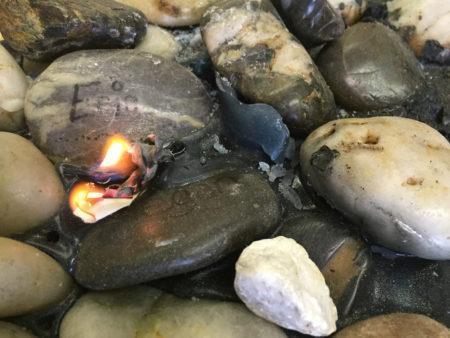
We are Sinners. Equally important, we are Beloved Children of God
Discussions of sin and forgiveness, and the acknowledgement that we are all sinners, are important. Equally important is the unequivocal message that we are so much more than our sins. Part 2 of this post “Beloved Children of God” discusses ways to help teens live into accepting their true self, and becoming the person God made them to be.
Did you enjoy this article? Consider subscribing to Building Faith and get every new post by email. It’s free and always will be. Subscribe to Building Faith.