
In the fall of 2025, we—Dr. Josh R. Ritter, Canon of Formation in the Diocese of Texas, and Suzanna Green, Director of Christian Formation for the Diocese of West Texas—formed a partnership to plan . . . something together. We noticed some common “pain points” in Christian formation in our respective dioceses. The focus on programs in formation was not meeting a need for practice. Trainings for formation leaders often felt stale because they fell into to “we’ve always done it this way” conventions. Additionally, a particular group in our dioceses, older adults, was lacking formation opportunities.
Our Idea: A Different Model for Forming Formation Leaders
Through our conversations, an idea arose. We would organize a weeklong gathering for formation leaders from a handful of churches in our dioceses. The gathering would introduce leaders to a small group discipleship model called “The Soul of Aging,” which was created in response to a need for deeper reflections in church and social communities around the topic of aging. This model seemed particularly helpful for our context because it could offer both a way for formation leaders to build capacity around skillful facilitation, discernment, and deliberation and greater insight for developing formation opportunities for older adults.
We also hoped to achieve a mindset among formation leaders that Christian discipleship must be experienced and practiced. It cannot simply be learned about. Practice is an essential ingredient of discipleship because we as Christians grow and deepen in faith by putting it into practice in our own lives and in community. Our discipleship is an expression of our commitment to our living and learning communities of faith as we live and learn into the shape of Jesus’s life and teachings together as Christian practitioners.
To that end, we asked those who took part in the training to commit to planning and leading a group in their parishes using the discipleship model within a year of the training. We also decided to expand the training to include six online sessions before the gathering and three follow-up online sessions afterward. Our aim was to help participants meet and get to know each other, begin discussing and practicing the discipleship model, and continue supporting one another as they started using the model in their parishes.
The Training
The pre-gathering sessions focused on exploring and practicing the “Circles of Trust” model developed by Parker J. Palmer in his book “A Hidden Wholeness: The Journey toward an Undivided Life” (Wiley & Sons, 2009). Dr. Mona West, Director of Adult Christian Formation at St. David’s Episcopal Church in the Diocese of Texas, led these sessions. During the sessions, participants began to practice key elements of Palmer’s model, like implementing several “rules” called “touchstones” and asking open and honest questions. Participants also learned about “third things,” Palmer’s way of introducing objects such as art, poetry, or essays that help draw participants toward deeper reflection.
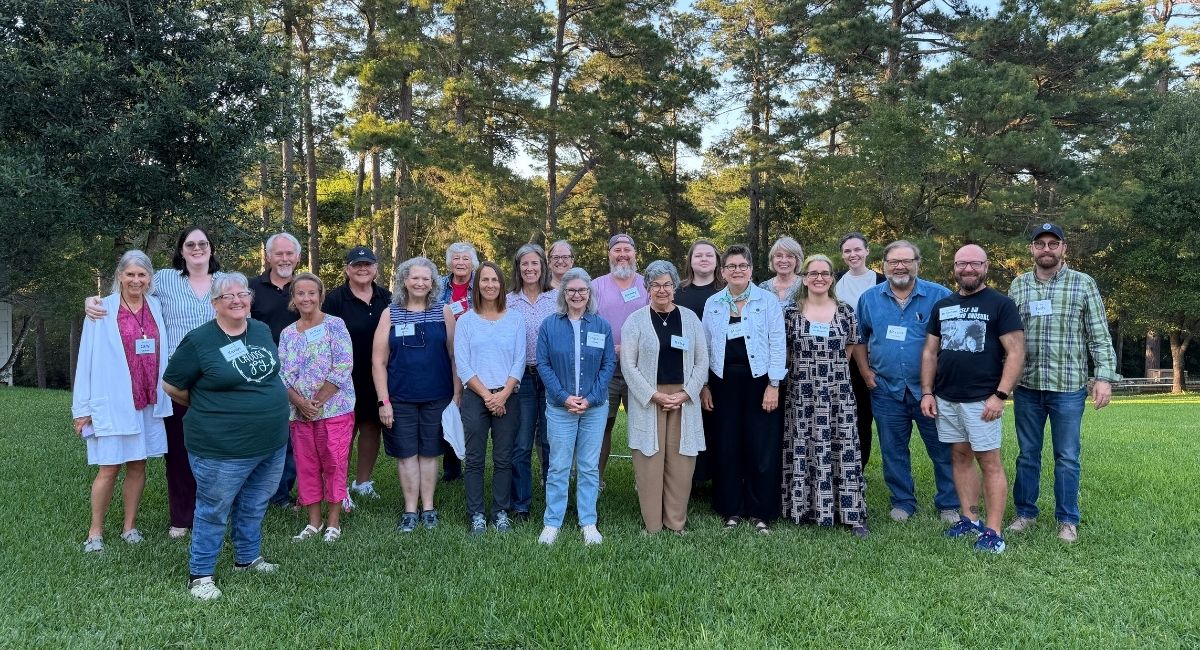
Our in-person gathering took place at Camp Allen in Navasota, Texas on May 11–14, 2026. The training sessions on “The Soul of Aging” were led by Caryl Casbon and Dr. Georgia Noble, MFT, who created this model of discipleship by adapting Palmer’s “Circles of Trust” to formation for aging and older adults. We also took time for fellowship, fun, connecting, and building relationships. We shared stories and laughter over daily meals and during evening social opportunities. Participants prayed and worshipped together each day, and they enjoyed getting to know folks from outside their own dioceses in a relaxed environment.
Our trainers are currently in the process of leading the series of follow-up online sessions. These sessions include a check-in time, time for participants to share their plans for their Soul of Aging groups and reflections on how the groups are going, and question-and-answer time. The follow-up sessions have allowed folks to continue to learn from one another and build on the relationships that started last spring.
Our Takeaways
We learned several important things from this collaboration. First, a lot of folks are interested in formation for older adults, and many were also willing to put in a significant amount of time online and in-person to learn this particular formation model. Second, doing all of the back-end planning was a lot more fun when the work was shared. Third, giving participants time during the training to think about their context and the way this model might work best in their unique setting allowed for planning to begin during the training itself rather than after participants returned home.
Ultimately, we sense a community of practice forming that isn’t just about a one-time training, but about a longer work of formation. Everyone who participated is supporting one another in their ministry work and discipling together. Additionally, we are hopeful that the groups that these formation leaders develop will be a way for churches to engage with their aging and senior adults and to go deeper into topics that don’t usually get talked about in coffee hour on Sunday mornings.
A Method for Diocesan Collaboration
Although a diocesan collaboration took a lot of work for us, it was also a chance to pool our collective resources and lean on each other’s strengths to create a learning experience that benefited both our diocesan formation communities. For those of you who may be interested in starting a collaboration between dioceses for your own formation gatherings or trainings, we want to share the method we used to work together.
1. Dreaming Together
The first step we took was dreaming together, and this required trust. In her book “Dare to Lead,” Brene Brown says that there is a vulnerability that happens at work that is a trusting of another with your sacred work (see “Dare to Lead” [Random House, 2018] as well as “The Anatomy of Trust,” Unlocking Us podcast [Nov. 24, 2021]). We had to trust one another so we could dream and be creative together.
2. Listening
Next, we listened. We listened to the folks in our diocese, and we listened to each other. We also listened to research and best practices.
3. Identifying “Pain Points”
Once we listened, we identified pain points. Much of this happened over time. We began with some initial brainstorming conversations based on the pain points, and slowly the specifics, such as which training to offer and when to offer it, began to fall into place.
4. Identifying Guiding Values for Collaboration
Then we identified values around which the entire collaboration took shape. The two values we focused on were unreasonable hospitality and good stewardship. While we had to plan something that fit into our respective budgets, we also wanted the training to truly have a retreat feel, to be a time set apart where participants could be fully immersed in “The Soul of Aging” and let go—even for a short time—of the constant motion of their ministry lives outside of the training. These values of unreasonable hospitality and good stewardship can of course be in conflict with one another. Ultimately, the balance of the two led to us offer something of extravagantly high quality that was also a good stewardship of financial resources and honored the participant’s time, skills, and talents.
5. Planning for Sustainability
Finally, we planned for sustainability. We didn’t want to just offer a typical one-off retreat that didn’t really provide tangible benefits or results for our leaders. We wanted to offer something that people could take home with them, and we wanted to provide ongoing support. It wasn’t just about a retreat or a training. It was about forming a community of practice.
Note: Due to the significant continued interest in the Soul of Aging and the success of the first training, a second training is being planned for spring 2027. Please reach out to either Josh or Suzanna if you are interested in hearing more about this offering.
Featured image is provided by article authors, Suzanna Green and Josh Ritter
Leave a Reply