How do we talk honestly about race as people of faith?
Over the past eight years, the Sacred Ground program has become a place to begin that conversation. This 11-session dialogue series offered by the Episcopal Church brings small groups together to explore the history of race in the United States through films, readings, and conversation. Along the way, participants consider the ways race is intertwined with family stories, economic class, political and regional identity, their own experiences, and their faith. The purpose is to understand how we got here, to consider where each of us fits into the story, and to envision a better path forward—and doing all of this as followers of Christ.
This is a great time to explore the Sacred Ground program, because a major curriculum update has recently been released. The year-long curriculum review and revision process involved not only the Sacred Ground staff, but also a team of reviewers from across the country. The update seeks to build on the proven effectiveness of Sacred Ground as a transformational adult formation resource for Christian communities of all denominations.
Why Do Congregations Choose Sacred Ground?
Sacred Ground is designed to meet participants wherever they are in their learning about race. It provides a way for people who are new to the subject of the history of race in this country to develop a basic understanding. Simultaneously, it gives people who have already spent time learning about racism an opportunity to dig deeply into their personal experiences, community history, and faith journey around race. That combination is part of what makes Sacred Ground unique. It invites participants to grapple intimately with what Christian faith offers us and requires of us.
The structure of the program matters, too. A Sacred Ground group—called a circle—stays together for 11 sessions, guided by volunteer facilitators. That commitment creates a kind of trust that is difficult to achieve in a one-time workshop, allowing honest sharing and exploration of challenging questions that might not be a part of folks’ everyday conversations.
The curriculum is free and ready to use. The preparation materials give facilitators what they need to effectively shepherd the group, while leaving room for customization in their particular contexts. While the curriculum was developed initially by The Episcopal Church, it has been used successfully across many denominations, a number of whom have contributed to recent curriculum edits and supplemental ecumenical resources.
The curriculum also has a long track record of success. A 2021 survey of Sacred Ground participants and organizers found that a large majority rated the program as extremely or very impactful. Participants have described the effect on them in simple but powerful terms. “I had no idea what it was going to be,” one participant said, “but it was completely compelling for me.” Another participant summed it up in one word: “Transformational.”
For others, the impact has been measured in what happens after the circle ends. One respondent wrote, “It has helped us take action on racial justice, not just preach about it.” Others reported that participants gained both knowledge and greater confidence in talking about racism with other people. Many participants reported exploring what they could do together in their congregation, diocese, or community to work toward racial reconciliation, healing, and justice.
What Is New in 2026?
The summer 2026 curriculum update grew out of listening to the people who have participated in Sacred Ground over the years. Feedback has demonstrated that people value the program’s history, films, readings, and conversations. At the same time, folks have been looking for a stronger spiritual dimension, materials that feel more relevant to our current time and place, and more support answering the question “What do I do now?” at the end of the circle journey.
The updated curriculum responds to those requests. Spiritual practices, including prayer, scripture, music, lamentation, and reflections on the labyrinth and baptismal promises, are more intentionally woven into the experience. These practices give participants ways to sit with what they are learning and to draw on the resources of their faith as they consider the path ahead. That is especially important given that, in other contexts, conversations about race can leave people feeling overwhelmed, angry, discouraged, or unsure about what they can actually do.
Sacred Ground doesn’t offer any set answers. Instead, across the 11 sessions, the updated curriculum prompts participants to connect what they are learning to their own lives and communities and to make themselves aware of the many ways in which they have the power to be a part of meaningful progress toward racial healing, reconciliation, and justice.
Getting Started
Because Sacred Ground is designed to be implemented at the congregational level, all of the resources for getting started are available on the website: Sacred Ground – The Episcopal Church. Whether you are interested in starting a circle, facilitating a circle, or taking the next steps after the Sacred Ground circle journey, you can find detailed information there.
Additionally, the Sacred Ground team is always here to support you on this journey. Reach out with questions or feedback at any time: [email protected].
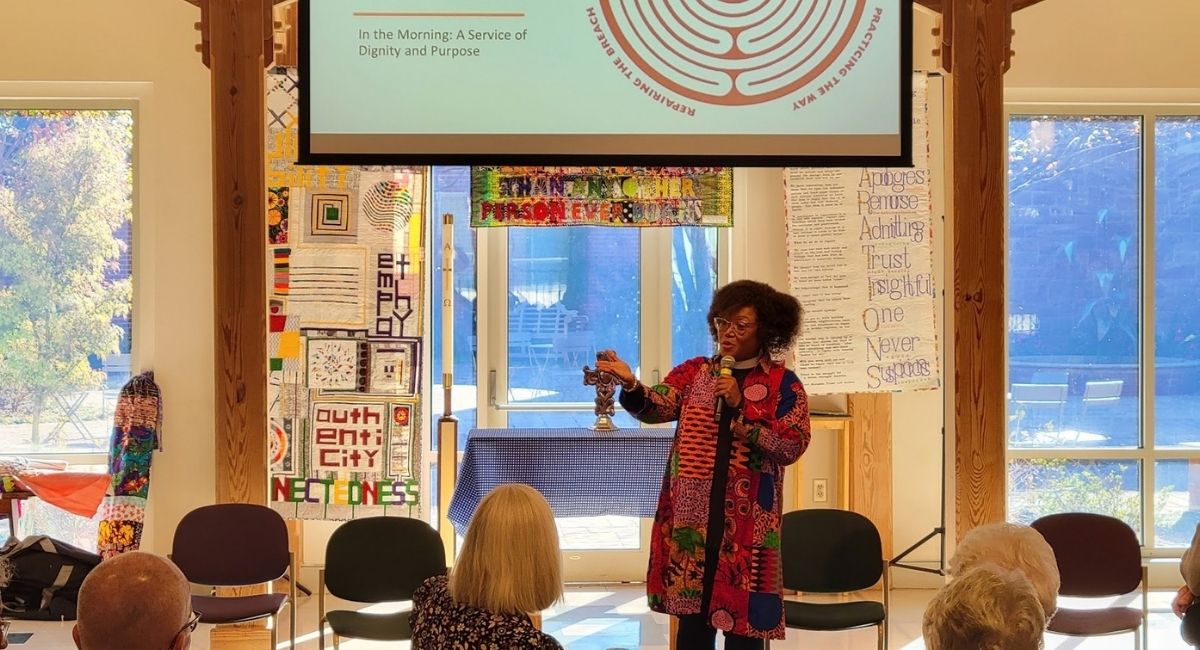
Featured image of the Rev. Valerie Mayo speaking at a regional Sacred Ground gathering in Durham, NC in November 2024 is by Christine McTaggart
Leave a Reply